

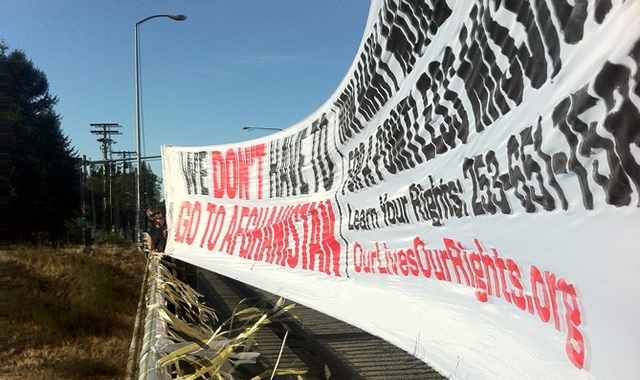
Soldiers at Joint Base Lewis McChord are being urged by the usual “peace” activists to desert their units and stay home from Afghanistan. This time around the message may be met with more than a little passing interest.
Chris Sullivan of KIRO 97.3 has done some solid reporting on this, getting some insightful interviews from rank and file soldiers who are wondering what the mission is in Afghanistan these days. I wonder too. Are we there for counterinsurgency? Are we there to win a war? Win hearts and minds?
As an example, I’ve spoken to two troops in just the past two weeks who have come home from Afghanistan and they’re PISSED about the Rules of Engagement (ROE) there. They believe the mission to ‘win’ a ‘war’ has morphed into a tub of goo with no apparent direction. They believe the ‘end’ of the war is set to a political time table and not to a time table connected to the real world and to a victory. This comports with the recent speech by CBS News’s Lara Logan. See my post here.
The Rules of Engagement in Afghanistan have stymied efforts to win a “war.” The war has morphed into training Aghan troops, which sounds nice, except it doesn’t appear to be working. Witness the recent murders of US Troops at the hands of Afghan “trainees.” If this happened in a US work place it would be called a massacre (unless, of course, it happened at Fort Hood by a radical Islamist and then it would be classified as workplace violence).
The author of the book about the mission to kill or capture Osama bin Laden, “No Easy Day,” writes about the Rules of Engagement when he left the zone:
“Everything in Afghanistan was getting harder. It seemed every rotation we had new requiments or restrictions. It took pages of PowerPoint slides to get a mission approved. Lawyers and staff pored over the details on each page, making sure our plan was acceptable to the Afghan government.
We noticed there were fewer assaulters on missions and more “straphangers,” each of whom performed a very limited duty. We now took conventional Army soldiers with us on operations as observers so they could refute any false accusations.
Policy makers were asking us to ignore all of the lessons we had learned, especially the lessons learned in blood, for political solutions. For years, we had been sneaking into compounds, catching fighters by surprise.
Not anymore.
On the last deployment, we were slapped with new a new requirement to call them out. After surrounding a building, an interpreter had to get on a bullhorn and yell for the fighters to come out with their hands raised. It was similar to what police did in the United States. After the fighters came out, we cleared the house. If we found guns, we arrested the fighters, only to see them go free a few months later. Often we recaptured the same guy multiple times during a single deployment.
It felt like we were fighting the war with one hand and filling out paperwork with the other. When we brought back detainees, there was additional two or three hours of paperwork. The first question to the detainee at the base was always, “Were you abused?’ An affirmative answer meant an investigation and more paperwork.”
This is no way to win a war. It is no way to fight a war. Perhaps that’s President Obama’s point.
I don’t blame these men if they don’t wish to go. We need a leader who will clarify the mission and who, instead of sending troops to manage a long slow surrender, will manage a war to kill these bastards.